
Snack Attack: Why Your Treats Cost More in Ireland
A short, sticky history of Ireland and its sweets
Let’s be honest: Ireland has never been shy about a sweet.
Back in the 1800s, Armagh-born Graham Lemon opened a confectioner’s on Sackville Street, now O’Connell Street, and turned sweets into a Dublin institution. Lemon’s got so famous that James Joyce slipped it into Ulysses, where Leopold Bloom wanders along “watchful among the warm sweet fumes of Graham Lemon” (not the worst place for a literary hero to loiter). Queen Victoria is recorded as dropping into the shop on her last trip to Ireland, in 1900. Even the 1916 Rising got a sugary footnote: the shop was looted, and the writer James Stephens noted that for the children who found the sweets, the whole insurrection “will have a sweet savour”. Lemon’s kept going until its Drumcondra factory closed in 1983, after protective tariffs came off and foreign competition arrived.
Meanwhile, in Limerick, the Condensed Milk Company of Ireland, founded in 1883, was busy with something a lot more fun than condensed milk: Cleeve’s Toffee, which stayed on Irish shop shelves into the 1980s. (Your dentist says hello.)
Then came the chocolate. Cadbury opened its first Irish factory on Ossory Road in Dublin in 1933, making just three products, Dairy Milk among them. By 1948 a chocolate crumb plant was running in Rathmore, Co. Kerry, so the chocolate could be made with Irish milk, and in 1957 production moved to Coolock, where the Twirl was invented in the 1980s.
Safe to say we did our bit. A 2004 report from Food from Britain had the Irish getting through 11.2kg of chocolate confectionery per person per year, the highest in the world (Switzerland came second on 10.7kg, the UK third on 9.8kg). Rankings move, and those figures are old, but you get the picture: this is a country that takes its sweets seriously.
So here is the question we couldn’t leave alone. We have always loved our sweets. But do we pay more for them than our neighbours do?
So what did we find?
Picture a box of sixteen Ferrero Rocher. At Tesco in Ireland it will set you back €11.75. The very same box at Jumbo in the Netherlands? €6.09. (That is not a typo.)
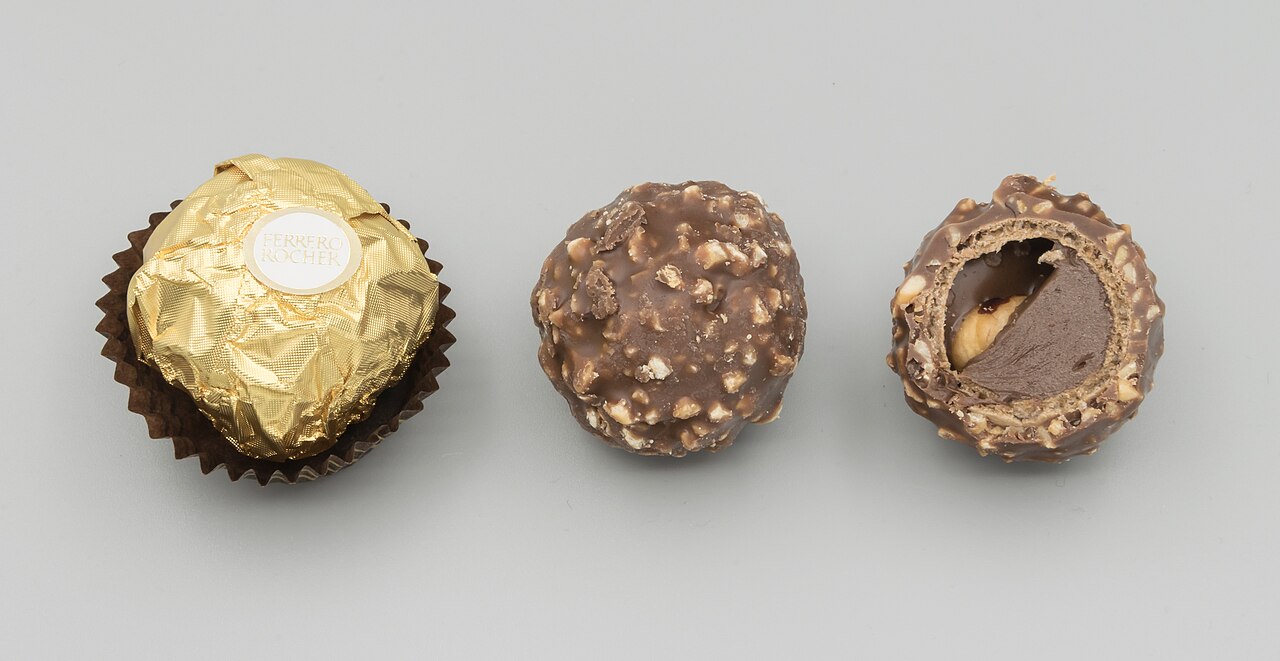 A Ferrero Rocher: wrapped, unwrapped and cut open. Photo: Jacek Halicki, CC BY-SA 4.0, via Wikimedia Commons.

One box proves nothing, of course, so we went hunting for the pattern. We took every chocolate, biscuit and cake we hold a recent price for and, because a sweet tooth tends to come with a salty side, every crisp, snack, nut and popcorn too. Then we compared the identical product across countries: same brand, same size, same everything. Ireland came out dearest. And not by a whisker.
What we compared
First, the homework. Tallywise knows about roughly 11,800 products across four aisles: chocolate and sweets, biscuits, packaged cakes, and crisps, snacks, nuts and popcorn. About 11,000 of them have a recent price. We looked at prices seen in the 45 days to 9 October 2026 and kept only products priced in at least two countries (about 3,000 of them), so a Kit Kat gets compared with the same Kit Kat and nothing else.
We left out loyalty-card-only prices and prices already flagged as errors. We also dropped the few products where two countries differed by more than three times, which usually means a data error (3 in the Ireland-UK comparison). UK prices are converted to euro at the ECB rate of 8 October 2026 (€1 = £0.84698).
We started with the three sweet aisles and added the savoury one afterwards. For continuity: on the sweet aisles alone, Ireland came out 26% dearer than the UK (811 products). With crisps, snacks, nuts and popcorn included it is 23% (1,012 products), because the savoury aisle’s gap is smaller, about 13%. Same answer, slightly gentler number.
The result
Drumroll, please. Averaged across products, using the median price among the shops we track in each country:
| Same product | Ireland is… | Products compared |
|---|---|---|
| Ireland vs UK | 23% dearer (95% range 21-25%) | 1,012 |
| Ireland vs Netherlands | 26% dearer (20-33%) | 68 |
| Ireland vs Belgium | 34% dearer (25-42%) | 59 |
The UK was the cheapest, or level with the cheapest: about 8% below the Netherlands on the 121 products they share. Against Belgium it was too close to call (85 products, a gap well inside the margin of error).
And it wasn’t one greedy aisle. Ireland was dearer than the UK in every aisle we looked at:
- Chocolate and sweets: 33% dearer (392 products)
- Biscuits: 23% dearer (290 products)
- Packaged cakes: 13% dearer (129 products)
- Crisps, snacks, nuts and popcorn: 13% dearer (201 products)
Ireland was dearer for about four in five of the products compared in each pairing (80% against the UK), so this is not a handful of overpriced items dragging the average up.
Ireland vs other countries (same product, 95% range)
- vs UK+23.3% (n=1,012)
- vs Netherlands (small sample)+26.1% (n=68)
- vs Belgium (small sample)+33.6% (n=59)
Ireland vs UK by aisle
- Chocolate and sweets+32.9% (n=392)
- Biscuits+23.1% (n=290)
- Packaged cakes+13.4% (n=129)
- Crisps, snacks, nuts and popcorn+12.7% (n=201)
Same shop, different country
- Tesco IE vs Tesco UK+15.8% (n=813)
Bar = how much dearer Ireland is for the identical product (+23% means Irish prices are 1.23 times theirs).
Black line = 95% range, where the true average very likely sits. Short means reliable, long means rough.
Pale bar = small sample, a direction not a precise figure. n = identical products compared.
Identical products, median shop price per country, prices seen in the 45 days to 9 Oct 2026, GBP converted at the ECB rate of 8 Oct 2026. Source: Tallywise.
Fair question: is it just the shops we track?
We wondered that too. The UK sample includes Asda, a discounter, and Ireland’s sample leans on Tesco. So we tried to break our own result.
- Same shop, different country. Tesco Ireland against Tesco UK, on 813 identical products: Tesco Ireland is 15.8% dearer (14-18%), and dearer for 75% of the products.
- Without Asda. Ireland against the UK with Asda removed from the UK side: 16.8% dearer (881 products).
- Without Tesco Ireland. Ireland against the UK with Tesco taken out of the Irish side, leaving Dunnes Stores and SuperValu: 33% dearer (463 products).
The size of the gap wobbles with the comparison, from about 16% to 33%. The direction never does.
Five products, side by side
All five are the identical product with recent prices, and it is Tesco against Tesco where we have both.
| Product | Tesco Ireland | Tesco UK | Elsewhere (cheapest we found) |
|---|---|---|---|
| Ferrero Rocher, 16 pieces (200g) | €11.75 | £7.50 (about €8.85) | Jumbo NL €6.09 |
| M&M’s Crispy pouch (107g) | €3.89 | £2.20 (about €2.60) | Albert Heijn NL €2.49 |
| Oreo Original twin pack (2 x 154g) | €3.19 | £2.00 (about €2.36) | Colruyt BE €1.58 |
| Lindt Excellence 85% cocoa (100g) | €4.85 | £3.50 (about €4.13) | Delhaize BE €3.69 |
| Walkers Ready Salted sharing crisps (150g) | €2.75 | £1.50 (about €1.77) | - |
The Irish Tesco price is 33%, 50% and 35% above the UK Tesco price on the first three, and 55% above on the Walkers sharing crisps. Then there is Lindt, which shows the gap is not the same everywhere: Ireland is still dearest, but only 17% above the UK and 4% above the Netherlands, although the cheapest shop we found, Delhaize in Belgium, has the same bar at €3.69, which makes Tesco Ireland 31% dearer than that. Not every product gets the same treatment.
Is it because it is made further away?
A fair suspicion, but we can’t test it properly: we can’t see where each product was made (Open Food Facts, the public database we checked, states a manufacturing place for only 45 of the 1,012 products). The best we could do was look at where the biggest brands’ makers have factories, and that gave no consistent answer. In the sweet aisles, brands with a plant in the UK or Ireland show the bigger Irish premium (+38% against +19% for Lindt, the only brand we found without one); in crisps and snacks it flips (+16% for Walkers, Doritos and KP against +33% for Pringles). Each comparison rests on a single brand, and a brand with a UK factory may still ship a given product in from elsewhere. Cadbury is the neat example: it has made Dairy Milk in Dublin since 1933, yet it is 44% dearer here than the same products in the UK. So we make no claim either way: our data can’t show that distance explains the gap.
Brand by brand
Is the gap really a brand-wide habit, or is it a few greedy brands? We looked at every brand with at least eight like-for-like products (23 groups, covering 646 of the 1,012 products). The honest summary: it is a habit most brands share, though some are keener on it than others.
Almost everywhere, the gap holds. In 15 of the 23 groups, Ireland is dearer for at least nine in ten of the brand’s products. Where the premium is smallest, it is still there: Walkers only about 8%, Ryvita 8% (and its range includes zero), Doritos 11%, Extra 12%. At the steep end, Nairn’s 78%, Barratt 65%, Rowntree’s 61%. Several brands at both ends have fewer than 15 products behind them, so treat their exact figures loosely. Tesco’s own label is the odd one out, about 5% cheaper in Ireland.
It isn’t just which shops sell them: comparing only Tesco Ireland with Tesco UK ranks the brands almost identically (rank agreement 0.94 across 21 brands, where 1.00 would be identical).
Brand explains about half the story (52% of the variation between products). The other 48% is within brands: Cadbury products run from -15% to +181%, with a middle of +41%. So the brand is a good guide, but not a guarantee.
So… why?
Here is where we have to be careful. We can tell you what the data shows, not what causes it, and we can say one thing, as far as our data goes: where a brand’s factories are does not give a consistent answer (see the section above), so “it’s made far away” is not something our data can show. Our figures cannot separate shop pricing, import costs, taxes, rents or wage costs. One thing we can check is VAT: sweets and chocolate are standard-rated in both countries (23% in Ireland, 20% in the UK, per Revenue and GOV.UK), and on its own that difference is only about 2.5% (1.23 divided by 1.20), nowhere near a 33% gap on chocolate and sweets. We did not check VAT on the other aisles. For context only: the Central Statistics Office reported that Irish food prices overall were 12% above the EU average in 2024, the third highest in the EU (CSO, “Price Levels of Food, Beverages and Tobacco 2024”, 23 July 2025). That report does not break out chocolate or biscuits separately, so we make no claim that it explains this gap.
What can a sweet-toothed person do?
You can’t change the price of a Ferrero Rocher, but you can find out which shop is cheapest for your own basket before you set off.
- Scan a product on the shelf and Tallywise shows the price at the other supermarkets we track.
- Build a basket of the things you actually buy and compare the total across shops. The cheapest shop for chocolate is not always the cheapest for the rest of the shop.
- Set a price-drop alert on the treats you buy regularly and let the app tell you when they dip.
How we did this (and where it is wobbly)
We would rather you trust the numbers than be impressed by them, so here is where they are weakest.
- Data. Prices come from retailer website listings and from shoppers scanning products and receipts. It is not a census of every shelf, and an online listing may differ from a shelf price.
- Like for like. The headline compares the identical product in two countries, so brand, size and pack count are the same. Where several shops stock it, we use the median.
- Promotions. Loyalty-card-only prices are excluded, but ordinary temporary price cuts are not, so one shop’s promotion can swing a single product.
- Exchange rate. Sterling is converted at the ECB rate of 8 October 2026. If sterling were 10% stronger, the Ireland-versus-UK gap would be about 12%, not 23%. It would still be Ireland that is dearer.
- Belgium and the Netherlands. Jumbo’s Belgian and Dutch prices for the same product are almost identical in our data (0.1% apart on average across 1,912 products), so our Belgian numbers lean on Jumbo. We do not draw conclusions about Belgium against the Netherlands.
- Germany, France and Spain are not ranked. Our German data is Edeka only, and only 41 products overlap with the other countries; France and Spain have even less.
- Sample sizes differ a lot. Ireland against the UK rests on 1,012 products; Ireland against Belgium on 59. Read the Belgium figure as a direction, not a precise number.
- What counts as the savoury aisle. Our “Crisps, Snacks, Nuts & Popcorn” aisle only; the neighbouring “Savouries & Snacks” and “Snacking” aisles are not included.
The analysis is reproducible and every number above comes from it.
Sources for the history. Lemon’s: The Irish News and Irish Academic Press. Cleeve’s: Condensed Milk Company of Ireland (Wikipedia). Cadbury: Cadbury Ireland timeline. Chocolate consumption: ConfectioneryNews, 20 January 2006. Cadbury in Dublin: Cadbury Ireland timeline. VAT: Revenue: chocolates, sweets etc. and GOV.UK: rates of VAT.